Lesson Plan: Writing Prompt

This is a lesson plan for highschool students, to be used as a writing prompt….

The Fame GaME

Many people thrive on the celebrity culture and the hopes that they can one day make it into the tabloids with fame and fortune at their beckon call. Many celebrities are even considered to be role models for young adults. Should they be? What makes a good celebrity role model? As aspiring actors, some of you might be the next generation of celebrities! How would you use your fame for good?

Writing Prompts…

Would you rather be famous for your talent or for a tabloid scandal?

How are you a celebrity in your own world? Is it “cooler” to be an individual or to model yourself after a trendy celebrity? What are celebrity trends that you just DON’T get?

How do celebrities affect your body image? Do you think they know? Do you think they care?

Has your opinion of one of your celebrity role models been changed based on their bad behavior? Think about Tiger Woods, or Lindsay Lohan. What would you say in a letter to them? No holding back!

What bad manners or behaviors do celebrities “get away with”? How would your relatives, teachers, or ‘authority figures’ react if you displayed those same behaviors?
Discuss a negative influence that a celebrity has had on your life or the lives of your friends.

Why do celebrity deaths deeply affect so many people? Think about recent celebrity deaths that might have been avoided: Michael Jackson, DJ AM, Britney Murphy, Heath Ledger, Anna Nicole Smith, etc. etc. etc.

Celebrities normally get paid many times the amount that firefighters, teachers and policemen earn.  Do you think celebrities make more money than they deserve?

Use a celebrity “catch phrase” as a hook, perhaps in opposition to how the phrase was intended. For example: “Celebrity DUI’s – not hot. Using your fame to raise money for Haiti? That’s hot.”

Does Fame bring happiness?

Dear _____________ you are NOT my role model….

If I was famous…..

What is Drama Therapy?

“All the world is not, of course, a stage,
but the crucial ways in which it isn’t are not easy to specify.”
–Goffman, The Presentation of Self in Everyday Life
Drama therapy is an effective means of making sense of and/or finding meaning in life. I believe creative self-expression is inherently healing and life enhancing. Through the process of self-expression, drama therapy can help people organize their inner reactions to events in their lives. Performance, embodiment and reflection enables them to understand and express their feelings more clearly. By encouraging creativity, imagination and role playing, persons reexamine or redefine their self descriptions (Garcia & Buchanan 112). The organizing function served by drama therapy enables clients to find meaning in their experience. This in turn may aid them in defining goals and desired outcomes.
WHY IS PERFORMANCE HEALING?
Embodying the role/counter-role/guide in the classroom setting has allowed me to understand its functionality in a therapeutic encounter. Reading about drama therapy followed by embodying the technique has provided a well rounded experience. I better understand the therapeutic goal of helping a client move towards a balanced state where problematic roles are integrated with appropriate counterroles by means of the transitional guide figure. The healing happens when the process allows clients to relate to the conflict caused by living in a paradoxical reality. This allows them to live a balanced life by accepting imbalance. Using performance as a tool to enact the roles and stories in their life gives them the healing benefit to acknowledge said roles and experience imaginary situations in a safe contained environment. Practitioners of developmental transformations believe the healing occurs fully through the play and drama and the reflection process is not necessary to affect change (Landy 113).
As Landy explained, when a protagonist is able to reflect on feelings experienced in the drama and relate it back to the group process and everyday life, catharsis of integration occurs (Landy 160).
HOW IS PERFORMANCE HEALING?
Performance is healing through the use of psychodrama when a client experiences catharsis by revisiting a painful experience and discharges anger through dramatic action. Dramatizing alternative stories offers a client new input and expands their repertory of roles. By dramatizing through performance a client begins to experience a shift which will eventually help to heal (Garcia & Buchanan 117).
Performance provides catharsis for the protagonist, but it is also healing from the spectator’s perspective. While watching the autobiographical performances I experienced several moments of catharsis; as described by Moreno when explaining Aristotle’s concept of catharsis. During various points of my classmate’s performances I was able to identify with the dilemma of the actor on the stage. As Moreno explained, the novelty and surprise of dramatic action fueled the release of feelings (Landy 136).
Through all of the various techniques explored in class I have come to discover many roles within myself. Many of these roles I was aware of and some of them came as a surprise. Through drama therapy I have learned that performance offers a whole new role and a new way of viewing life. Situations and roles that were introduced in class were carried over into “real life”. The most exciting aspect of my newfound perspective towards drama therapy is learning how my passion for drama and the theater can be applied towards meaningful, respectful work that can help to empower people to change their life in a very personal way.
References

1) Landy, Robert. The Couch and the Stage. United Kingdom: Jason Aronson, 2008.
2) Garcia, Antonina and Buchanan, Dale Richard. Psychodrama: Chapter 9.
Current Approaches in Drama Therapy. Charles C. Thomas:Springfield, IL. 2000.
3) R. Landy. Essays in Drama Therapy: The Double Life, Jessica Kingsley Press, 1996

Storytelling

NYU Storytelling Seminar Reflection Paper
11/20/09

Truth be told – when I signed up for this seminar I picked it because it was only one credit and it rounded out my credit requirements for the semester. I thought storytelling was interesting, but I didn’t see how it applied to my educational aspirations and career goals. Boy was I wrong! I can honestly say that the seminar has overwhelmingly exceeded my expectations. Not a day has gone by in which I didn’t apply an aspect of the storytelling lessons to my everyday life.
For instance, the day after the seminar I had been hired to babysit for my neighbor. Bedtime rolled around and the outraged toddler was on the verge of throwing a massive temper tantrum.  I tried to bribe her with her favorite book, which she completely rejected and threw across the floor. Thinking about the seminar from the night before, I had a light bulb moment. I asked her, “Would you like to hear a new story about my friend Mr. Wiggle?” She exploded into a fit of giggles, stating, “That’s a silly name!” Long story short, I had her in the palm of my hand as I reenacted the tale of Mr. Wiggle. She agreed to go to sleep because Mr. Wiggle slept in the story. Crises averted. The next day her mother called to ask about this Mr. Wiggle that her daughter wouldn’t stop talking about. Weeks later, I babysat this 3 year old again and she was delighted to tell me the story of Mr. Wiggle. I was shocked that she was able to recall so many details of the story. It was a “real life” affirmation of the lessons that Regina gave. People remember details when given in story form.
The storytelling games and activities were extremely helpful to me as well. I’m a writer and I have already used several of the “story prompts” to aid me in my writing. They are perfect when I experience the dreaded “writer’s block”. I especially like the activity that we used to incorporate things we saw overnight into a story. I appreciate these types of activities and I believe they will be useful in my career when I will be working with students to write their own scenes or monologues.
I have been able to integrate storytelling into other aspects of my life as well. I am always astonished watching my boyfriend interact in professional settings and group situations. I tease him that he has a “golden tongue”. It seems like when he talks he has his audience hanging on every word. When he is talking about business proposals, new ideas and concepts, he always makes a story out of it. He is extremely animated, convincing and confident when he speaks and seems to always get his way. I’m extremely jealous of his “gift of the gab” and often find myself trying to mimic his mannerisms, to no avail. When Regina taught us some techniques about storytelling I was excited to experience an “ah ha!” moment. She had specifically told us about the importance of descriptive details when we tell our stories.  I immediately thought about my failed attempts at storytelling and public speaking. In my efforts to engage my audience with a story, I rush over the most important part. The details! I now realize that I was too self-conscious to indulge my listeners in the details on the story. Before this class, when I told stories I thought it was more important to focus on the arc of the story rather than waste time by focusing on the details. I would get frustrated when my listeners seemed to only be “half-listening” and I couldn’t figure out why! I now understand how wrong I was in my assumption.
The most important tool I have taken away from this seminar is my new found wisdom to be expressive, descriptive and detailed in my storytelling. It has helped me in every aspect of my life: talking in front of a classroom; public speaking; dinner conversations; job interviews; auditions; writing papers; playwriting…. the list goes on and on! This seminar has proven to be an invaluable gift in helping me express myself.

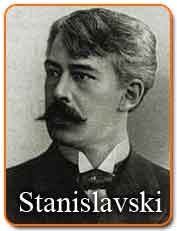
Constantine Stanislavski

NYU Research Paper: Drama in Education
October 26, 2009

Influential Theatre Practitioner of Drama in Education: Constantine Stanislavski
Written and Researched by Andrea Bertola

“Create your own method. Don’t depend slavishly on mine. Make up something that will work for you! But keep breaking traditions, I beg you.”
– Constantine Stanislavski

Preface
When the topic of “method acting”, “acting systems” or “acting techniques” arises you can be sure that a passionate debate is soon to follow. This was evidenced in one of my classes here in the Educational Theatre Department when the question came up, “Should we teach acting techniques in academic classrooms?”  I was astonished to find that only a handful of students seemed to share my opinion that, YES, it should be taught; despite any controversy surrounding acting methods. My argument being: as instructors of drama and theatre it is our responsibility to introduce students to the foundations of these acting techniques and let them decide if it is something that works for them. My classmates seemed to feel as though these acting methods are too advanced for young students in classroom settings and we shouldn’t be teaching them as though they are going to be professional actors. Quite frankly, that notion made my blood boil— just a little bit.

Chemistry teachers teach advanced formulas and chemical mixing, even though their students aren’t growing up to have a career as a chemist.  Calculus teachers teach complicated equations, even though their students aren’t growing up to have a career as a mathematician.  Why is there a bias against Drama in the classroom? Hearing this argument coming from the mouths of my fellow classmates was truly disheartening. What was even more upsetting to me was that because I hadn’t explored this topic in-depth; I lacked confidence in defending my stance. Of course I know the general fundamentals of acting methods, I had even work at the Lee Strasberg Theatre Institute; but when it comes to key contributions, influences, history and foundations— I am eager to learn more about the man who was a pioneer in this field. This has inspired me to choose Constantine Stanislavski for the purposes of this research paper and explore the many ways he has been an influential practitioner of Theatre.

Stanislavski’s Key Contributions
to the Field of Educational Drama and Theatre
Constantine Stanislavski is often called, “The Father of the Acting System.” It would perhaps be less of an undertaking to explain where he hasn’t contributed to the field of Educational Drama and Theatre.  He dedicated his life to creating a system, that would help in organizing and strengthening the creative process known as acting. This system is a result of his efforts to determine how a human being can control in performance the most intangible and uncontrollable aspects of human behavior, such as emotions and artistic inspiration. In essence, his constant goal in life was to formulate some codified, systematic approach that might impart to any given actor with some grip on his ‘instrument’, that is, himself (Benedetti).  What Stanislavski had undertaken is not to discover a truth, but to bring the truth in usable form within the reach of those actors and producers who are fairly well equipped by nature and who are willing to undergo the necessary discipline (Hapgood 2). And that is exactly what he did. His contribution to modern acting and drama technique is still at the core of mainstream western performance training for much of the last century.

Stanislavski’s teachings of the realist method can be broken down into two main theories. His early teachings were based mainly on the concept of “Emotional Memory/ Affective Memory Technique” and later his development of his “Method of Physical Actions”. Within those broader concepts are some of his following theories and techniques: Active Analysis, Action, Adaptation, Cognitive Analysis, Communication, Concentration of Attention, Etude, Experiencing, Given Circumstances, Imagination, Indicating, Inner Contact, Inner Monologue, Intention, Justification,  Lure,  Objective, Super Objective, The Questions, Relaxation , Representation, Sense Memory,  Subtext ,  Substitution,  Through-line of Action, and Turning Point (Hapgood 1989).

 His contributions span even further when you look at his contributions to the field of psychotherapy and the influences he has had on the development of drama therapy/theatrotherapy and therapeutic theatre, which will be discussed later in this paper.

Theoretical Framework Situated within the Field      
Within the field of educational theatre Stanislavski’s contribution can be most recognized when looking at the teaching method of Process Drama where both the students and teacher are working in and out of role. I found a really insightful article entitled, Emotional Involvement or Critical Endangerment?, which discussed The Schools Council Report of 1977. This report pointed out the strong connection between educational process drama and theatre when it noted that “both essentially rest on the ability to adopt and develop roles and characters within ‘as if’ situations” (Wooster 15). I can’t help but notice the blatant parallels between this statement and Stanislavski’s “magic if” which he uses to suspend reality and unlock creative empathy. The article also addressed the needs of teachers in using drama or theatre within the National Curriculum and demonstrated how good drama actually facilitates a fusion of ‘critical detachment’ from Brecht and ‘emotional involvement’ from Stanislavski (Wooster 14). The philosophies of these two practitioners are often viewed as contrasting, but the article claims the two approaches actually come together, in using drama and theatre in education as an empathetic rather than as a performance discipline.

Influences on other Drama Practitioners
It is clear that almost every significant method of acting & theatre training in America was derived from the work of Stanislavski. His influences on Lee Strasberg, Uta Hagen, Stanford Meisner and Stella Adler are obvious. Beyond training for actors, contemporary drama theorists also employ his philosophies.  Good drama education technique has been derived from various schools of theatre which are all dependent upon the human ability to play and think creatively and empathetically (Wooster 16). Being that Stanislavski’s influence is so vast, I am going to briefly touch on one practitioner from several different categories to speak of Stanislavski’s contributions in the following areas: Drama in Education; Drama Therapy; Process Drama; Improvisational Theatre; and Method Acting.

Dorothy Heathcote (Drama in Education)
Stanislavski’s theory of ‘emotional memory’ is evident when examining Dorothy Heathcoat’s philosophy on drama education. Her method is based upon the desire to assist in the development of her students by encouraging social and emotional growth. She uses the idea of affective memory technique that actors would identify as coming from Stanislavski. She wants a ‘feeling’ response from her students so that a child will ‘think from within a dilemma instead of talking about a dilemma’ (Heathcote 200). Much of her approach is based on authenticity, attention to detail and respect for what is true (Bolton 244). This seems to be reflective of Stanislavski’s method for achieving the truthful pursuit of a character’s objective.

Robert Landy (Drama Therapy: Role Theory)
Landy’s ‘role theory’ is supported by theatrical influences over and above his sociological sources (Landy 101). Much of Stanislavski’s approach was influenced by Freud. Looking at his affective memory method in psychological terms, the raw emotional experience of the id was to be mediated by the ego, grounded firmly in reality. It’s easy to see how this theory can be linked to Landy’s development of “role”, “counter role” and “guide”.

Cecily O’ Neill (Process Drama)
Process Drama is a method of teaching and learning where both the students and teacher are working in and out of role. Cecily O’Neill describes process drama being used to explore a problem, situation, theme or series of related ideas or themes through the use of the artistic medium of unscripted drama. Structure and Spontaneity talks about Cecily O’Neill’s belief that actions and gestures need to be layered in to a process drama. She has examined the theories of Stanislavski among others and how their notions of improvised activity and organic episodic structure can yield fertile discoveries (Taylor 116). 

Viola Spolin (Improvisational Theatre)
Improvisational Theatre is a form of theatre in which the actors use improvisational acting techniques to perform spontaneously. Stanislavski’s actor training relied heavily on improvisation in actor training and rehearsals.  His theories and method are reflected in Viola Spolin’s method that was greatly influenced by Stanislavski.  Spolin is considered by many to be the “American Grandmother of Improvisational Theatre”. She adapted the techniques of Stanislavski to devise a series of over 200 acting games and exercises (Taylor 32).

Lee Strasberg (Method Acting)
Lee Strasberg founded the first American acting company to put Stanislavski’s “emotional recall” theories into practice. Modern day controversy surrounding Stanislavski’s system or “method” perhaps comes from being confused with Lee Strasberg’s “method acting”. In Stanislavski’s system, actors deeply analyze the motivations and emotions of their characters in order to personify them with psychological realism and emotional authenticity. Using Strasberg’s Method, an actor recalls emotions or sensations from his or her own life and uses them to identify with the character being portrayed (Strasberg 42).

Connections: Stanislavski’s work as it connects to my own practice
I haven’t yet decided which path I am going to follow when it comes to my life in the theatre. Working at the Lee Strasberg Institute has inspired me to possibly go the entrepreneur route and open my own school for acting one day. If I pursue this option, no matter which technique I choose to teach, I know that it will be influenced by Stanislavski’s method.  As an acting teacher no matter who I teach, whether it is young children in their first play or professional actors on the verge of getting their big break, my goal will be to get them to play their role as truthfully as possible. Stanislavski treated theatre-making as a serious endeavor, requiring dedication, discipline and integrity, and the work of the actor as an artistic undertaking. When I think of my teaching philosophy, these are the very same words that come to my mind. In that way, Stanislavski will be influencing my work on a daily basis, no matter which career path I choose in the world of educational theatre.


Works Cited
  1. Benedetti, Jean. Stanislavski and the Actor. London: Methuen, 1998
  2. Bolton, Gavin. Acting in Classroom Drama. Portland, ME: Calendar Islands Publishers, 1999.
  3. Hapgood, Elizabeth Reynolds & Stanislavski, Constantine. An Actor Prepares. New York, NY: Routledge Theatre arts Books, 1989.
  4. Heathcote, Dorothy. Drama as a process for Change in Drain. Twentieth Century Theatre. London: Routledge, 1995.
  5. Landy, Robert. The Couch and the Stage. United Kingdom: Jason Aronson, 2008.
  6. Strasberg, Lee. A Dream of Passion. New York, NY: Penguin, 1987.
  7. Taylor, P. and C. Warner.  Structure and Spontaneity:  The Process Drama of Cecily O’Neill.  London: Trentham Books, 2006.
  8. Wooster, Roger. Emotional Involvement or Critical Endangerment? Drama Magazine. Summer: 2004.

Drama Therapy, Class 1

We talked a lot about the duality of theatre and its relation to psychology. In theatre as well as drama therapy we use symbols as emotional safety. Metaphor is used to open up the experience. Metaphor incorporates “both and” vs. “either or”. Through this duality we find the balance in things, people and their personalities. Finding balance, keeping life balance is the goal in life.
Through “the couch and the stage” exercise we began to explore the differences between the two. I was surprised to discover that I gravitated more towards the couch when asked questions regarding: “Where do you feel safe”, “where are you the most yourself”, “where do you heal”. I think I picked the couch, because even though the theatre is my second home, the nature of the theatre implies a performance. When you are performing you are putting yourself out there to be judged, to be viewed. You are acting. I don’t think it is possible for me to be my truest self, under those circumstances.
I was really interested to find that the earliest forms of drama therapy were taken from Shamanism. I have always been drawn towards the occult and find it fascinating that the early shamans used a form of performance as a way to heal. In shamanism the spiritual world centers on the convergence with body and spirit. Natural and supernatural events heal physical and psychological illness. Both are spiritually based. They use herbal remedies and performing arts, music, dance, etc. to heal the unquiet mind.
I found the idea of these healing rituals fascinating and am thrilled to learn that drama therapy’s roots are based in something that I hold close to my heart.

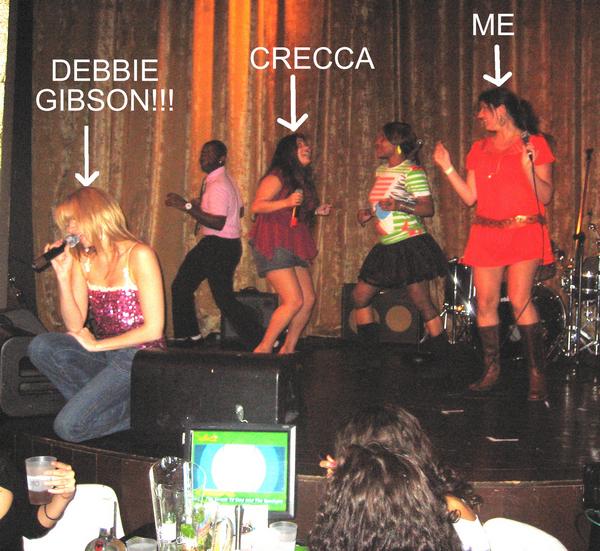
I sang on stage with Debbie Gibson!

I thought this picture was “blog worthy”. YES. It is true. Me and Crecca were on stage singing karaoke with DEBBIE GIBSON!  ::Backflips::

Lets state the facts:

1) It was 80’s karaoke night, in a new Karaoke Bar in Time Square.

2) Debbie Gibson was HOSTING karaoke, all night!

3) The only reason why I would go to a bar in Times Square is for Debbie Gibson hosting an 80’s karaoke night.

4) I was with my best friend, and karaoke partner-in-crime, Crecca.

5) Debbie Gibson was my first celeb obsession, and my VERY first concert with my friend, Erica!

6) Crecca and I were Hyperventilating to even be in the same ROOM as Debbie!

7) Debbie called us on stage to sing our song. We picked “I love rock and roll.” (Of course).

8) She touched my shoulder!!!!!

9) Afterwards she came on-stage and asked if we were Debbie Gibson fans.

10) We squealed something incoherent. At an ear spitting pitch.

11) She asked, “Would you like to sing a song with me?”

12) More squealing.

13) She told us we’d have to learn the original dance moves from the original tour.

14) She taught us the moves to “Shake Your Love.”

15) And then we sang back-up to Debbie Gibson. 

16) Crecca and I swore we can now retire as karaoke artists. Our career is complete.

17) Yeah. right. “Only in your dreamsssss.”

Ode to SMUT…

Going through some of my old files… I came across this gem. Let’s take a trip down memory lane, shall we?


Ode to SMUT 
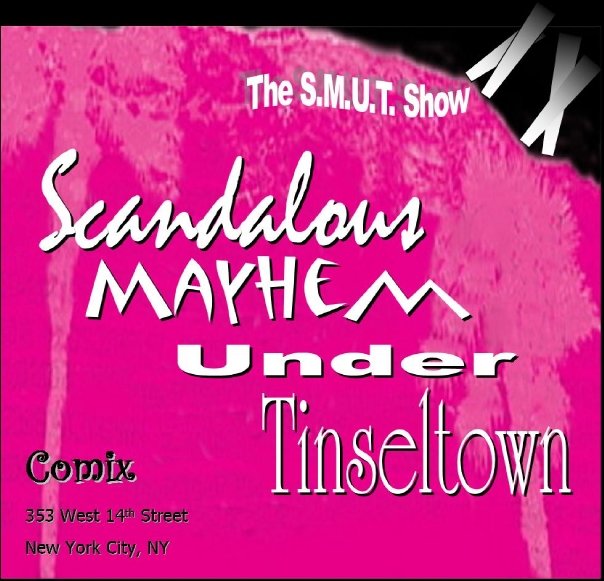
(Scandalous Mayhem Under Tinseltow)
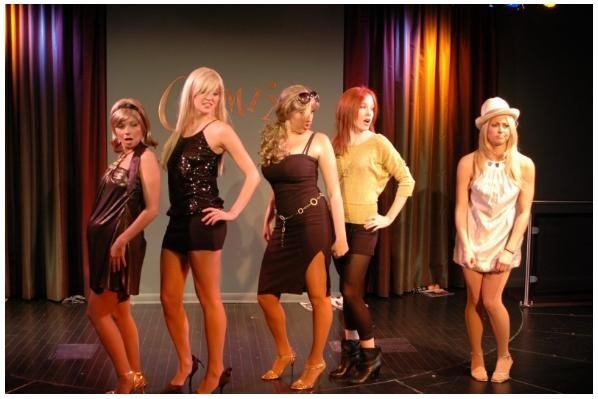
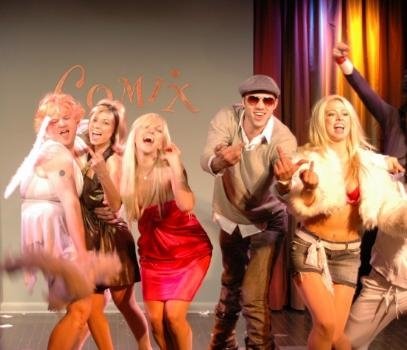
This scene was written for The S.M.U.T. Show, performed December 2007 – March 2008 at Comix Comedy Club.
Copyright:Andrea Bertola. All Rights Reserved.
Characters: NICOLE RITCHIE, PARIS HILTON, LINDSEY LOHAN, BRITNEY SPEARS AND JESSICA SIMPSON.

Lights up on five hollywood socialites spread across the stage. Each one of them has a tabloid magazine open infront of her face. They each have an oversized purse filled with the “props” needed for this scene.

NICOLE
(Brings magazine down, reveals face)
Red carpet
BRITNEY
(Brings magazine down, reveals face)
Or in magazines
PARIS
(Brings magazine down, reveals face)
We are Hollywood’s beauty queens.
JESSICA
(Brings magazine down, reveals face)
You say our looks are all we’ve got?
LINDSEY
(Brings magazine down, reveals face)
We don’t care because…
PARIS
(Toss magazines aside)
“That’s hot”!
NICOLE
We’re socialites, we live the dream.
LINDSEY
The trends we set become mainstream.
PARIS
From Uggs to Juicy,
BRITNEY
Pinkberry too!
JESSICA
We start the trends we see on YOU.
NICOLE
From Boho chic 
BRITNEY
To trucker hats
LINDSEY
High heels one minute; the next its flats.
 PARIS
Jimmy Choos
NICOLE
(Points to her shirt)
And vintage tees
JESSICA
Sushi for lunch!
ALL
NEVER Chinese.
PARIS
(Show dog in purse)
Small dogs we carry in a purse.
NICOLE
A baby bump is not a curse!
LINDSAY
Blond, brunette, then Blond again–
JESSICA
–Our hair dresser is our best friend.
 Hair extensions down to our waist–
BRITNEY
–Fake hair’s a trend we must embrace!
All pull out various phones, text or talk into phone over next section.

LINDSAY
We use Blackberry’s or the iphone
JESSICA
“Girls Wanna Have Fun” as our ringtone!
PARIS
(on blackberry)
We text all day, and text all night—
BRITNEY
“Real” conversations just don’t feel right.
NICOLE
 For gossip we love TMZ!
PARIS
I only read the stories ’bout me.
JESSICA
We go on myspace, stalk our dates.
Why is SHE on HIS Top 8?!
LINDSEY
(Walks over to RAPPER GUYS, flirty)
Bed-hopping, boyfriend-swapping you can trade with me.
(RAPPERS do a “take”)
BRITNEY
(Pointing to guys in audience)
I fucked him once, 
LINDSEY
I’ll fuck him twice.
PARIS
“What’s an STD?”
(They all shrug)
Pause.
NICOLE
We give great head with one demand–
JESSICA
You know your wish is our command.
BRITNEY
Make sure you film us,
PARIS
Blackmail the tape.
 A sex-tape scandal, we can’t escape!
NICOLE
(indicate Paris)
One night in Paris, you want a piece?
PARIS
(TO Nicole)
When you bed us, sign a release…
(They all pull a “release” from behind their backs. Hold out to the audience)
BRITNEY
We meet our men at the nightclub.
LINDSEY
We only go where we can snub.
PARIS
Bottle service and V-I-P
All
(Pointedly)
No, you cant sit down with me!
NICOLE
So whateves, I’m such a bitch
I don’t care, I’m filthy rich
LINDSEY
O-m-g. I’m such a snob
But that chick needs a good nose job.
PARIS & NICOLE
(indicate Britney)
Fix her cankles and muffin top
JESSICA
 (To both)
Call her doctor, “Chop, chop, chop”.
PARIS & NICOLE
(To eachother)
Cat fights with our frienemies
 We declare on message tees.
BRITNEY
Team Aniston
LINDSAY
vs. Team Jolie
NICOLE
Or team Nicole
PARIS
vs. Team Pariee.
BRITNEY
(Puts on huge sunglasses)
To escape the drama we run away
JESSICA
(Puts on huge sunglasses)
Save it for another day.
PARIS
(Puts on huge sunglasses)
To the spa
NICOLE
(Puts on huge sunglasses)
Or to the beach
LINDSEY
 (Puts on huge sunglasses)
Anywhere we can’t be reached.
BRITNEY
When we fly its just first class
PARIS (or skinniest girl cast)
Big seats are needed for a little ass.
LINDSEY
We’ll travel far for a weekend trip
JESSICA
We only go if the place is hip.
BRITNEY
Maui!
NICOLE
Ibiza!
PARIS
 St.Tropez!
LINDSAY
South beach, Miami is kind of gay.
JESSICA
Paris for shopping, but The French are creeps.
All
(To pump up a NYC Audience)
We love New York, the City never sleeps!!!!
(Applause, hoots, hollers!)
 PARIS
(All take off sunglasses)
At trendy restaurants we see and be seen
 NICOLE
Eat dinner? No way, I’ll have a saltine.
LINDSAY
Koi, the Ivy or Mr. Chow.
BRITNEY
The Olive Garden?
PARIS
EW, lowbrow!
NICOLE
Our figures resemble preteens’
We wear size zero, skinny jeans
JESSICA
Diet fads, or the master cleanse
BRITNEY
It makes us shit, so we wear ‘Depends’!
(Lifts skirt to reveal Depends)
LINDSAY
We live on coffee from Mr. Bean.
Red bull addicts,
ALL
(A bit crazed))
Need more caffeine!
BRITNEY
A Starbucks run for a photo opt.
NICOLE
We flick off cameras and tell them…
ALL
(Bitchy, half-assed)
“Stop”.
PARIS
(posing)
Oh paparazzi, we love you–
JESSICA
(sarcastic, indicating Paris)
–But posing is just so taboo.
LINDSAY
When we get a d-u-i
The public is our alibi.
NICOLE
And when we have our day in court–
PARIS
–We know we’ll have our fans support.
BRITNEY
We make headlines at any price.
LINDSAY
The tabloids are our main device.
JESSICA
(Over enthusiastic) 
We love the attention, we live for fame!!!
NICOLE
Gossip is the name of the game.
LINDSAY
So say we’re a hoe.
BRITNEY
Call us a slut.
 All
Just keep buying your Celebrity Smut.
BLACKOUT
Sound cue: “Beverly Hills”, Weezer.
The SMUT Show

The S.M.U.T. Show: 
Scandalous Mayhem Under Tinseltown

@ COMIX COMEDY CLUB
NEW YORK CITY, NY
NEW YORK, March 3 /PRNewswire/ -- What happens when you mix tabloids +
 sketch comedy? S.M.U.T (Scandalous Mayhem Under Tinseltown) announces its
 red carpet opening night at Comix, Thursday, March 6th, 2008 in an
 unlimited engagement.

     Let's face it, celebrity scandal is EVERYWHERE and we're
 hooked-celebrity pregnancies, meltdowns, rehab visits, Hollywood DUIs and
 of course the never ending public fascination to fuel the drama. Previewed
 in December to sold out audiences at Comix, S.M.U.T is a first of its kind
 parody based on celebrity culture that provides the same fix of Hollywood
 gossip in theatre form, with a twist.

     S.M.U.T was produced by Ei8ht 22 Productions
and written by a group of seven NYC twenty and thirty somethings
 obsessed with celebrity culture. The production follows a fast-paced comedy
 sketch style similar to that of Saturday Night Live and each week, the team
 meets to update the show with the very latest developments in the tabloids
 and must-see material. The show features a hugely talented cast including
 Lorraine Bracco's niece Lindsay Bracco, playing the roles of all the usual
 suspects.

     The 25 sketches that makeup the show include skits such as: Sex Ed with
 Paris and Nicole, A Moment with the Cruises, Perez Hilton: Gateway to Hell,
 On The Playground-celebrity offspring sharing the woes of having famous
 parents, to name just a few. Musical numbers include "I Think I'm A Clone
 Now", "Oops I f'd Up Again" and "Maternity World".

     "I wanted to lure generation Y back to theatre again and what better
 way than through their everyday obsession," explained Steve Shaw, director.
 Writer/Producer Andrea Bertola conceived the idea for the show and
 explained, "We're all obsessed with the unraveling of Hollywood lives! We
 all wake up in the morning and log onto Perez Hilton everyday... so we
 decided to have a little fun and take our obsession to another level."

     Tickets are $20 in advance or $25 at the door (plus a 2 drink minimum
 purchase) and can be purchased online at www.comixny.com or by calling 212-
 524-2500. Show times are as follows:

     3/6, 3/19, 4/10, 5/1, 5/22 at 8pm. Further dates to be announced.

Ode to “SMUT”
“I hate you, my friend”
Brangelina in “Couple’s Therapy”
Paris Hilton and Nicole Richie
Avril Lavigne
Brad Pitt
Brittany Spears
Brittany’s famous UMBRELLA attack.
Tom Cruise and Suri
Gwen Stafani and Perez Hilton
Back Stage!