I had originally decided to deconstruct Klaus Kinski’s book, “Kinski Uncut”. As I was reading it, the text was so dark that I thought it would be interesting to juxtapose it with something really childlike and innocent. “Kinski Uncut” follows Klaus through his chaotic life. It’s an erotic story as he explains (it vivid detail) his never-ending desire for women. I thought juxtaposing this story with “Oh the places You’ll Go” would be very interesting. That particular Dr. Seuss book is often given out as a graduation present. It is a symbol for the opportunities that lay before a young person. I wanted to explore what happens when a person takes the wrong road. I also wanted to explore Klaus’ book from the perspective of the scorned women he left behind. I chose to have the (literally) hundreds of women he left behind represented in one person. Of “all the places you’ll go” how far could a person get to that line? What is the ultimate revenge? I wanted to push myself in this scene and explore a really dark topic. I wanted to see if I would be able to create and direct a powerful piece that doesn’t rely on fluff, pop culture, comedy or any other tricks I have up my sleeve.
Below are some excerpts I cut from the Dr. Seuss poem. As you can see… when they stand alone they are quite dark:
Oh! The Places You’ll Go!
You won’t lag behind, because you’ll have the speed.
You’ll pass the whole gang and you’ll soon take the lead.
Wherever you fly, you’ll be best of the best.
Wherever you go, you will top all the rest.
Except when you don’t. Because, sometimes, you won’t.
I’m sorry to say so but, sadly, it’s true that Bang-ups and Hang-ups can happen to you.
You will come to a place where the streets are not marked.
Some windows are lighted. But mostly they’re darked.
A place you could sprain both your elbow and chin!
Do you dare to stay out? Do you dare to go in?
How much can you lose? How much can you win?
You can get so confused that you’ll start in to race down long wiggled roads at a break-necking pace and grind on for miles across weirdish wild space, headed, I fear, toward a most useless place.
The Waiting Place…for people just waiting.
I’m afraid that some times you’ll play lonely games too.
Games you can’t win ‘cause you’ll play against you.
All Alone!
Whether you like it or not, Alone will be something you’ll be quite a lot.
And when you’re alone, there’s a very good chance you’ll meet things that scare you right out of your pants. There are some, down the road between hither and yon, that can scare you so much you won’t want to go on.
But on you will go though the weather be foul.
On you will go though your enemies prowl.
On you will go though the Hakken-Kraks howl.
Onward up many a frightening creek, though your arms may get sore and your sneakers may leak.
On and on you will hike.
And I know you’ll hike far and face up to your problems whatever they are.
I took the idea of “the waiting place” and thought of it as a sort of ‘Limbo’ where people are waiting all alone. They might have to face their fears. A “weirdish, wildish space where you find things that “scare you so much you won’t want to go on”. I decided to use the idea of abortion and a woman’s womb. A woman taking back control of her body. I wanted it to be heavy on symbolic meanings so that an audience could impose their own story on the piece. I wanted to play with universal themes. However, I needed to have a very clear story for my actress. You can’t play universal themes if you don’t have an underscoring thru line. This just leads to confusion.
The story we came up with for my actress:
She was in love with Klaus and would do anything to be close to him; however he just used her for sex. (like many of the women he describes in the book). She was poor, desperate and not well educated. She has no identity other than when she is with him. He gives her self-worth. The type of woman that puts a man before herself. No confidence, no self respect. She found out she was pregnant with his baby and he wanted nothing to do with her. This enraged her. She thought the baby would change their relationship. She despised him and she despised herself. Even worse she despised his growing fetus inside of her. The rage empowered her to take the life of the baby. She tried to terminate the pregnancy. She ended up killing herself in the process.
As the scene begins she wakes up in a hazy fog, as she finds herself in “limbo”… however she doesn’t know where she is yet. She finally discovers the blood on her hands (symbolic) and realizes where she is. She tries to wipe the blood off her hands and this results in staining her white dress with blood (symbol). She starts hearing voices and seeing bits of her life flash before her. She hears her own voice and sees herself in the mirror. The last voice of Klaus, saying, “We can’t be together right now.” She falls to the floor in a fit of despair. As she rises, we see that her skirt is covered in blood. Her womb bleeds for him.
She finds the bowl of water and decides to cleanse herself. (A symbolic baptism). As she pours the clear water into the bowl, it fills with red blood. She tries to cleanse the blood from her hands and at the bottom of the bowl she discovers the placenta. She instantly connects with it and mothers it. She rocks it and kisses it. Sorry that she terminated the fetus’ life out of revenge. For once, she is in control. She has her own identity away from Klaus. In a final symbolic moment she ingests the placenta as a way to become whole once more. She has resolved her tormented feelings and can leave limbo. Symbolically the baby with go with her. Blackout.
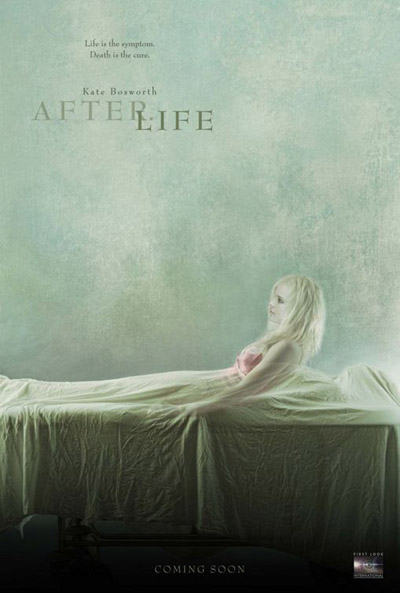
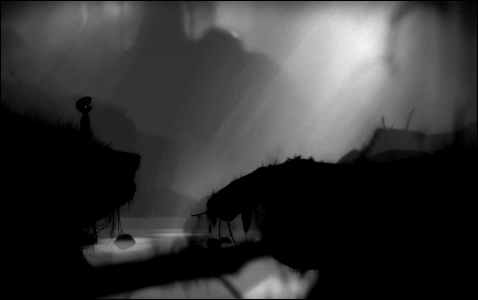
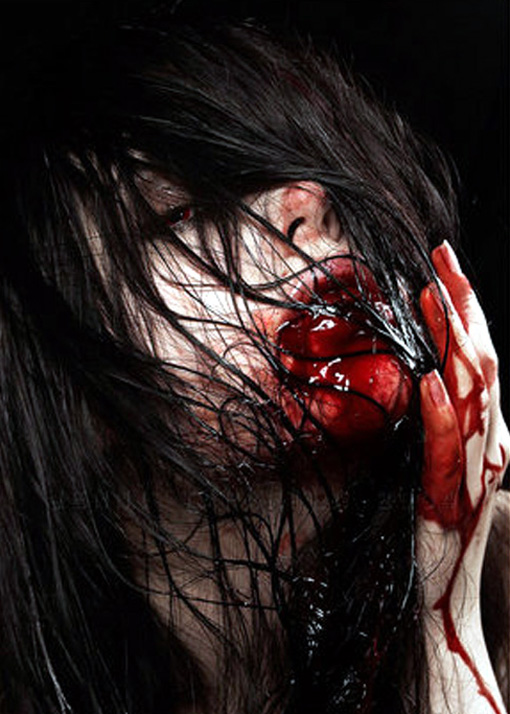
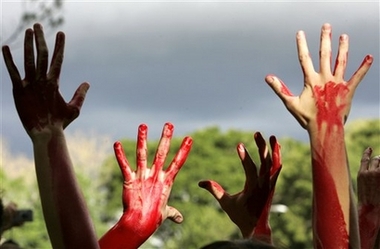
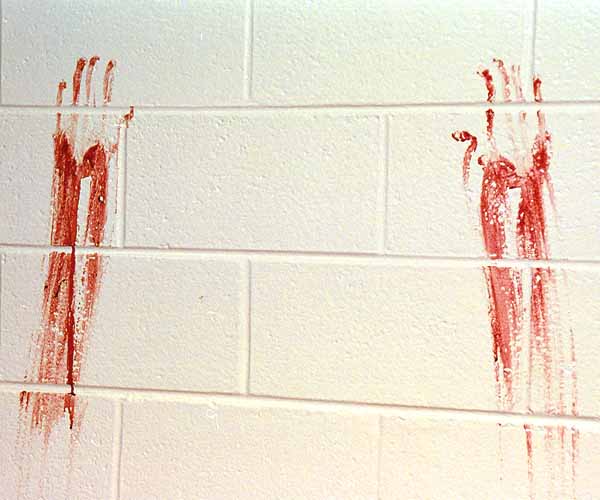
Inspiration Pictures:
Yikes. Pretty sick. I don’t know where this piece came from! But I think it’s beautiful at the same time. Though I’m prochoice, I didn’t want this piece to be political in nature. I tried to find balance. She terminated the pregnancy, which is a prochoice stance… yet she ended in limbo, which leans towards the stance of the prolife team. However, she could be in limbo for a number of reasons: killing herself, revenge, unresolved issues, self loathing…etc. She could be in limbo because the baby died with the “original sin”. Or it could be perceived as a dream/nightmare.
Luckily enough after scouring the internet for audio versions of the poem, I found a version that someone had made for an art project. They had used some of the text, but integrated it with really creepy music! Perfect.
I wanted to use a fog machine… I felt it was really important to create the right atmosphere.
In rehearsal we did a ton of emotional work as we deconstructed the moments. I wanted her emotional reactions to the scene to be authentic. Everything else is so gruesome and horrifying that we need the audience to become immediately invested in her and willing to go with her on the journey. I felt as though leaving a sense of ambiguity would “hook” them. Their curiosity would lead them through our story.
Each person in the audience will be engaged as they as themselves:
Who is she?
Where is she?
What is wrong with her?
Who are the voices she hears?
What does the blood represent?
What does her white outfit represent?
What does the water represent?
And finally, I hope it would foster dialogue and begin a conversation on the ‘controversial’ subject of abortion, life, death and the afterlife.
After notes:
I was thrilled with my scene. I was glad the smoke machine worked so well. I own the machine and have used it in numerous performances before so I knew how to alter it for the purpose of using it in a classroom environment. I had adjusted the ratio of “smoke juice: to water” this way it wouldn’t bother anyone’s eyes, or lungs…and it wouldn’t set of the smoke alarm in the building. It’ was basically a 90% water solution. This worked against me in some ways, because had there been more fluid the smoke would have stayed in a thicker layer on the floor, instead of rising up and evaporating so quickly. I had really hoped to create the illusion of her walking through the clouds…but I think a moody atmosphere was achieved, so I’m happy with that. The scene was visually beautiful. I think the grey walls, big windows, and use of the setting natural light really helped to set the mood. The red blood added serious “shock value” especially against her stark white dress in the blank space. I was excited when people had asked me later— “where did you hide all of the blood?” This was the first time I had ever used elements of “magic” in my scene and I’m glad that it turned out so well! I definitely ruined a couple of shirts practicing THAT one… but it was totally worth it.
This scene was such a stretch for me and I was cringing while I watched the scene. It went against every bone in my body to rely so heavily on the emotional work with my actress. I have never used a bare stage and those first minutes of her exploration killed me! I was afraid the audience would be bored! I had to trust myself and trust our work. I was rewarded as I watched the faces of the audience and they seemed to be captivated! Success!


 Andrea Bertola Shaw